Cyprus has finally run out of quick-fix solutions to save its economy - just as it takes the reins of the EU presidency
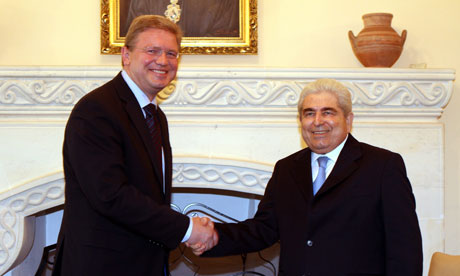
Cypriot president Demetris Christofias (R) shakes hands with Stefan Fule, the EU commissioner on enlargement and European neighbourhood policy in Nicosia, Cyprus. Photograph: Katia Christodoulou/EPA
The timing could not be worse. Just days before Cyprus is due to take up the European Union's presidency and the task of guiding Europe out of its financial crises, it has become the fifth eurozone member to request a Brussels bailout.
It does not bode well that a bailout country is now mandated with securing agreement on the financial framework of Europe's budget for the next seven years. The Germans have already started to make noises about Cyprus holding the presidency while trying to negotiate a loan. But the government has chosen to draw attention to itself, and the plight of its economy, by waiting until the last moment to ask for a little help from its friends.
There was time to apply for a bailout in an orderly fashion, but Cyprus waited until it was pushed into a corner – after negotiations for a loan from Russia or China failed – and the world's media is, unsurprisingly, zoning in on the sticky situation – hardly the best way to encourage investor confidence, or show that Cyprus is a capable player on the European stage.
Cyprus is the eurozone's third smallest economy, but has managed to make the whole of Europe twitch over the possibility of the contagion spreading across the single currency bloc.
The Mediterranean island was undone by a banking sector heavily exposed to debt-paralysed Greece and a write-down of Greek bonds, which hit Cypriot banks hard, pushing Nicosia to seek help just as it picks up the six-month rotating presidency.

