Showing posts with label EU. Show all posts

Tuesday, July 3, 2012

Euro zone factories hit hard in June, job cuts rise

View of the Renault headquarters in Boulogne-Billancourt, near Paris January 11, 2011. REUTERS/Jacky Naegelen


By Yati Himatsingka

LONDON | Mon Jul 2, 2012 6:38am EDT


(Reuters) - Euro zone manufacturing took another hefty blow in June and factories are preparing for worse to come, according to business surveys on Monday that showed jobs were cut at the fastest rate in two-and-a-half years.

Markit's Eurozone Manufacturing Purchasing Managers' Index (PMI) was unchanged at 45.1 in June, above the preliminary reading of 44.8 and holding at its lowest reading since June 2009.

Anchored below 50 mark that divides growth and contraction for almost a year now, the survey again showed factories in the region's two biggest economies, Germany and France, are succumbing to a downturn that started in southern Europe.

Companies are clearly preparing for worse to come, cutting back on both staff numbers and stocks of raw materials at the fastest rates for two-and-a-half years," said Chris William son, chief economist at data provider Markit.

The PMI suggests that the goods-producing sector contracted by around 1 percent in the second quarter, with this steep rate of decline looking set to accelerate further as we move into the second half of the year."

Monday, July 2, 2012

Debt Based Banking: It's All About to End

Sorry for the doom and gloom, but it really isn’t. When is the beginning of the end of a prison a bad thing when the good guys are on the inside and the guardsmen are bankers?


When I say ‘It’, I don’t just mean a snivvly little recession, or even a depression, I mean the whole system of fiat currency and debt financing. As a recap, fiat currency is not backed by anything, so its value is only what people trust it is worth. Now that people are realising that our money is NOT backed by gold or metals or anything, and that even making money out of thin air won’t solve the problems, our trust in the very paper money causing the problems is, well, nil. When I say ‘debt financing’, I mean that everything is based on debt. This starts with the central banks, which lend money to governments and populations at interest, which requires more money to be printed to pay off the original currency issue, and so on and so on.

The first video explains the debt financing side of things, and the second video explains the fiat currency side of things (fractional reserve banking). Take both together, and you can see that we are deliberately indebted with money that is worthless:


Now, Business Insider has four articles all at once that say ‘the game is over’!


Article 1: Why The Debt-Dependent Status Quo Is Doomed in One Chart (click to go to article)


In a nutshell, this article explains why the world can no longer pay for its debt, and thus, the system can no longer keep going. Here is a fancy-looking graph that shows that our economies are addicted to debt-financing – ie when we can no longer raise and pay for new debt, the economy suffers (ie has no actual cash reserves to carry on):


Libor scandal: George Osborne to announce independent inquiry - Serious Fraud Office considers possibility of criminal charges at Barclays

Chancellor likely to stop short of full-scale inquiry, as Serious Fraud Office considers possibility of criminal charges at Barclays


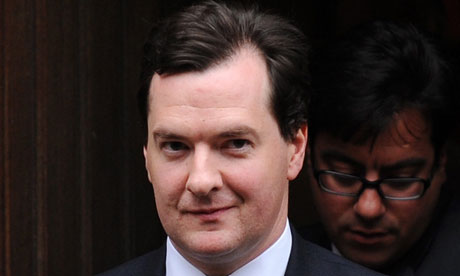
George Osborne
George Osborne is expected to give a statement to the Commons about the banking scandal on Monday afternoon. Photograph: Andy Rain/EPA


George Osborne is expected to announce an independent inquiry into the future operation of Libor, the inter-bank lending rate, but will stop short of setting up a full-scale Leveson-style investigation into banking culture and practices.

The chancellor is also expected to set out details of a brief consultation into the extension of criminal offences for corporate negligence. Downing Street said Osborne would make a statement in the House of Commons on Monday afternoon.

The prime minister's spokesman ruled out a full-scale inquiry, saying: "We know what happened."

Ahead of the Commons statement, the Serious Fraud Office said it would decide within a month whether there were any grounds for a criminal investigation at Barclays, which was fined a record £290m last week for attempting to manipulate key benchmark interest rates. Fourteen of its staff were implicated.

"Now that the investigation into the issue of regulatory misbehaviour has concluded, the SFO are considering whether it is both appropriate and possible to bring criminal prosecutions. The issues are complex and the assessment of the evidence the FSA [Financial Services Authority] has gathered will take a short time, but we hope to come to a conclusion within a month," the agency said.

Finns, Dutch cast first doubt on euro zone deal

Finland's Prime Minister Jyrki Katainen leaves a two-day European Union leaders summit in Brussels early June 29, 2012. REUTERS/Sebastien Pirlet


By Terhi Kinnunen

HELSINKI | Mon Jul 2, 2012 8:42am EDT


(Reuters) - Finland and the Netherlands, the euro zone's most hardline creditor states, cast the first doubts on Monday on a European summit deal designed to save Spain and Italy from being engulfed by the currency bloc's debt crisis.

The Finnish government told parliament that Helsinki and its Dutch allies would block the euro zone's permanent bailout fund buying bonds in secondary markets, despite an agreement among leaders' last Friday that the fund could be activated to stabilize markets.

The euro fell, European stocks gave up gains and safe-haven German Bunds reversed losses on news of the Finnish statement, which raised fears that the latest deal which drew a positive initial market reaction could unravel.

Several previous market rallies after euro zone crisis agreements have fizzled within a day or two as investors have fretted about the lack of detail, the risk of delay and national vetoes, or the inadequate size of the rescue funds available.

The 17 euro zone leaders agreed in Brussels on steps to shore up their monetary union and bring down borrowing costs for Spain and Italy, regarded as too big to fail but also too expensive to rescue if they are shut out of markets. They gave few details on the use of the temporary EFSF and permanent ESM rescue funds.

ESM bond buying in secondary markets would require unanimity and that seems unlikely because Finland and the Netherlands are against it, the Finnish government said a report to a parliamentary committee.

Sunday, July 1, 2012

Judgment day looms for banking sector

A bad week for banks (or their customers), Italy trounces Germany (at the euro summit) and Brits put their faith in Spain (well, its beaches)


Lord Turner
Lord Turner, chairman of the Financial Services Authority, said that the failure of the banks was 'a public concern'. Photograph: Bloomberg/Bloomberg via Getty Images


Ever since the taxpayer was forced to bail out the UK's banks, there has been a steady stream of commentators asking why none of the bankers involved have had their collars felt. This week the government will wade in when it responds to the Financial Services Authority's report on the collapse of Royal Bank of Scotland. George Osborne is set to launch a consultation floating the idea of criminal sanctions against directors of failed banks where there is evidence of negligence.

When the FSA's hefty 452-page report was published last December, Lord Turner, its chairman, said that the failure of banks was a "public concern" because their collapse resulted in "taxpayer losses and wider economic harm".

He added: "The fact that no individual has been found legally responsible for the failure begs the question: if action cannot be taken under existing rules, should not the rules be changed for the future?"

Well, change looks to be coming, helped along by the interest rate rigging scandal, which has helped pull confidence in the country's banks down to a new low. Sadly those at the helm of the banks bailed out in 2008 – like Fred Goodwin and Andy Hornby – have nothing to fear. Only future bank failures will be covered.

Friday, June 29, 2012

Eurozone bank bailout deal throws lifeline to Spain and Italy

Italy and Spain stunned Germany by blocking progress until they obtained softer bailout rules in 14 hours of bad-tempered talks


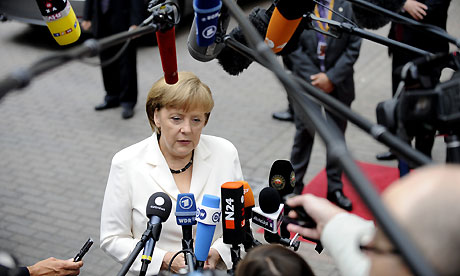
German chancellor Angela Merkel
German chancellor Angela Merkel arrives for day two of the summit in Brussels on Friday. Photograph: John Thys/AFP/Getty Images


European leaders have pulled back from the brink of disastrous failure in their attempts to rescue the euro, throwing a lifeline to the weakest links in the eurozone by agreeing to shore up struggling banks directly, remove disadvantages for private creditors and move quickly towards a new supervisory regime for banks.

David Cameron said on Friday: "The countries of the eurozone did take some important steps forward last night. There's still important work to do."

Amid bad-tempered talks that continued through the night, Italy andSpain stunned the Germans by blocking progress on an overall deal at a two-day EU summit in Brussels until they obtained guarantees that the eurozone would act to cut the soaring costs of their borrowing.

The tough negotiations were deadlocked for hours, prompting the departure from the summit after midnight of the 10 non-euro countries, including Britain, leaving the eurozone leaders to fight it out.

Wednesday, June 27, 2012

Europe's leaders at odds before summit


Demonstrators wearing masks depicting German Chancellor Angela Merkel (L-R), Spanish Prime Minister Mariano Rajoy, Italian Prime Minister Mario Monti and French President Francois Hollande, pose as they simulate playing a soccer match to protest against the euro zone debt crisis, in front of the Chigi palace in Rome, June 22, 2012. The message on the goal post reads: ''Tax on the financial transactions''. REUTERS/Remo Casilli


By Julien Toyer and Thorsten Severin

MADRID/BERLIN | Wed Jun 27, 2012 8:50am EDT


(Reuters) - European leaders sound unusually divided before a high-stakes summit, with Germany's Angela Merkel saying total debt liability would not be shared in her lifetime and giving little support to Italian and Spanish pleas for immediate crisis action.

Rome and Madrid have seen their borrowing costs spiral to a level which for Spain at least would not be sustainable as it battles to recapitalize banks ravaged by a burst property bubble and cut a towering government deficit.

Spanish Prime Minister Mariano Rajoy said on Wednesday he would ask other European Union leaders to allow the bloc's bailout funds or the European Central Bank to stabilize financial markets.

Speaking in parliament before a meeting of European heads in Brussels on Thursday and Friday, Rajoy warned that Spain would not be able tofinance itself indefinitely with 10-year bond yields near seven percent.

Cyprus's request for a bailout greatly raises the fear of contagion

Cyprus has finally run out of quick-fix solutions to save its economy - just as it takes the reins of the EU presidency


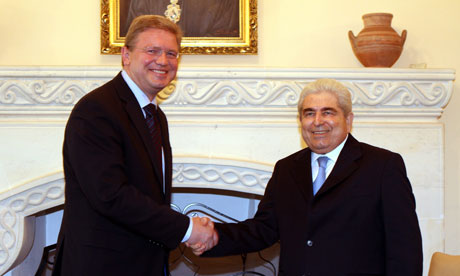
EU Commissioner on Enlargement and European Neighbourhood Policy Stefan Fule visits Cyprus
Cypriot president Demetris Christofias (R) shakes hands with Stefan Fule, the EU commissioner on enlargement and European neighbourhood policy in Nicosia, Cyprus. Photograph: Katia Christodoulou/EPA


The timing could not be worse. Just days before Cyprus is due to take up the European Union's presidency and the task of guiding Europe out of its financial crises, it has become the fifth eurozone member to request a Brussels bailout.

It does not bode well that a bailout country is now mandated with securing agreement on the financial framework of Europe's budget for the next seven years. The Germans have already started to make noises about Cyprus holding the presidency while trying to negotiate a loan. But the government has chosen to draw attention to itself, and the plight of its economy, by waiting until the last moment to ask for a little help from its friends.

There was time to apply for a bailout in an orderly fashion, but Cyprus waited until it was pushed into a corner – after negotiations for a loan from Russia or China failed – and the world's media is, unsurprisingly, zoning in on the sticky situation – hardly the best way to encourage investor confidence, or show that Cyprus is a capable player on the European stage.

Cyprus is the eurozone's third smallest economy, but has managed to make the whole of Europe twitch over the possibility of the contagion spreading across the single currency bloc.

The Mediterranean island was undone by a banking sector heavily exposed to debt-paralysed Greece and a write-down of Greek bonds, which hit Cypriot banks hard, pushing Nicosia to seek help just as it picks up the six-month rotating presidency.

Tuesday, June 26, 2012

Cyprus's request for a bailout greatly raises the fear of contagion

Cyprus has finally run out of quick-fix solutions to save its economy - just as it takes the reins of the EU presidency


EU Commissioner on Enlargement and European Neighbourhood Policy Stefan Fule visits Cyprus
Cypriot president Demetris Christofias (R) shakes hands with Stefan Fule, the EU commissioner on enlargement and European neighbourhood policy in Nicosia, Cyprus. Photograph: Katia Christodoulou/EPA


The timing could not be worse. Just days before Cyprus is due to take up the European Union's presidency and the task of guiding Europe out of its financial crises, it has become the fifth eurozone member to request a Brussels bailout.

It does not bode well that a bailout country is now mandated with securing agreement on the financial framework of Europe's budget for the next seven years. The Germans have already started to make noises about Cyprus holding the presidency while trying to negotiate a loan. But the government has chosen to draw attention to itself, and the plight of its economy, by waiting until the last moment to ask for a little help from its friends.

There was time to apply for a bailout in an orderly fashion, but Cyprus waited until it was pushed into a corner – after negotiations for a loan from Russia or China failed – and the world's media is, unsurprisingly, zoning in on the sticky situation – hardly the best way to encourage investor confidence, or show that Cyprus is a capable player on the European stage.

Euro market lockdown feeds bank dependence on ECB

The Euro sculpture is pictured in front of the headquarters of the European Central Bank (ECB) in Frankfurt January 24, 2012. REUTERS/Lmar Niazman


FRANKFURT | Tue Jun 26, 2012 9:15am EDT


(Reuters) - Banks' demand for European Central Bank funding surged on Tuesday to 180 billion euros, well above expectations, more than four times the demand just a month ago and the latest evidence of a growing crisis-driven dependence on ECB funding.

The euro zone's problems have choked off bank-to-bank lending. Only the safest banks in core parts of the bloc are still able to borrow on the open markets, leaving those in Spain, Italy and other countries with outsized debt burdens increasingly reliant on the ECB for their funding.

A total of 180 billion euros ($225 billion) was taken by 105 banks at the ECB's weekly handout of limit-free, 1 percent, 7-day loans.

It was higher than the 167 billion euros 101 banks borrowed a week ago, well above the 169 billion expected to be taken and far exceeded the 38 billion euros that 84 banks took at the equivalent operation a month ago.

Although banks may temper their appetite for 3-month ECB loans available on Wednesday, their soaring demand for its funding is likely to be a source of serious concern for the ECB.

The central bank has pumped over a trillion euros of 3-year cash into the banking system since the end of December, a move it could have expected to satisfy banks' needs comfortably.

Monday, June 25, 2012

Cyprus applies for EU bailout

By Michele Kambas


NICOSIA | Mon Jun 25, 2012 12:45pm EDT


(Reuters) - Cyprus became on Monday the fifth euro zone country to seek financial assistance from the EU's rescue funds, announcing it was applying for a bailout for its banking sector hit by exposure to the crisis in Greece.

Tiny Cyprus needs to raise at least 1.8 billion euros - equivalent to about 10 percent of its domestic output - by June 30 to satisfy European regulators about the health of Cyprus Popular Bank, which saw its balance sheet hurt by bad Greek debt. It may seek more.

"The purpose of the required assistance is to contain the risks to the Cypriot economy, notably those arising from the negative spillover effects through its financial sector, due to its large exposure in the Greek economy," a government announcement said.

With its coffers emptying rapidly and hurtling towards an immovable deadline, the island suffered a further fiscal sovereign credit rating cut to non-investment, or junk, status by Fitch at BB+.

With a bailout widely viewed as all but inevitable, Cyprus has for weeks been trying to juggle its options between a bailout from Europe's rescue funds, the temporary EFSF and the permanent ESM, or a bilateral loan from either Russia or China.

Spain requests EU aid, market hopes dim

A cleaner cleans the facade of a Bankia-Caja Madrid bank branch in the Andalusian capital of Seville June 25, 2012. Spain formally requested European aid for its banks on Monday but did not specify how much money it will seek to recapitalize the indebted lenders. REUTERS-Marcelo del Pozo


MADRID/BRUSSELS | Mon Jun 25, 2012 9:44am EDT


(Reuters) - Spain formally requested euro zone rescue loans on Monday to recapitalize banks that are laden with bad debts as the euro and shares fell due to investors' skepticism that a European Union summit this week will act decisively on the bloc's debt crisis.

Spanish Economy Minister Luis de Guindos asked for up to 100 billion euros ($125 billion) in a letter to Euro group chairman Jean-Claude Juncker, saying the final amount of assistance would be set at a later stage.

He confirmed his intention to sign a Memorandum of Understanding for the package by July 9 and said the amount should be enough to cover all banks' needs, plus an additional security buffer.

The EU's top economic official, Olli Rehn, said a deal on terms for the loan from Europe's bailout funds could be concluded in a matter of weeks.

"The policy conditionality of the financial assistance, in the form of an EFSF/ESM loan, will be focused on specific reforms targeting the financial sector, including restructuring plans which must fully comply with EU state aid rules," he said.

Europe's Tower of Babel hampers euro solution

(From L) French President Francois Hollande, Italian Prime Minister Mario Monti, German Chancellor Angela Merkel and Spanish Prime Minister Mariano Rajoy take their seats for a meeting June 22, 2012 at Villa Madama in Rome. REUTERS/Lionel Bonaventure/Pool


By Paul Taylor

PARIS | Mon Jun 25, 2012 3:38am EDT


(Reuters) - As Europe considers a leap towards closer integration to try to save the euro single currency, it resembles the biblical Tower of Babel - unable to complete an ambitious project because the residents don't speak the same political and economic language.

The spotlight is on Germany, France, Italy and Spain, the euro area's four biggest economies, wrestling over proposals for a banking union, joint euro zone bonds and handing more control over national budgets and economic policy to the European Union.

But Europe's Babel features 27 often fierce national debates in member states, each of which has the power to block any change to EU treaties, including 10 countries which are not members of the currency.

Each national argument uses a different political vocabulary and historical context, making them hard to reconcile at the best of times and harder still when the going gets tough.

While investors are looking for quick, bold solutions to restore confidence in the euro, Europe's patchwork politics make rapid strides fearsomely difficult, if not impossible. Each major step is subject to ratification by national parliaments or referendums, which can easily trip the project up.

Sunday, June 24, 2012

Banks downgraded as size of Spanish crisis revealed


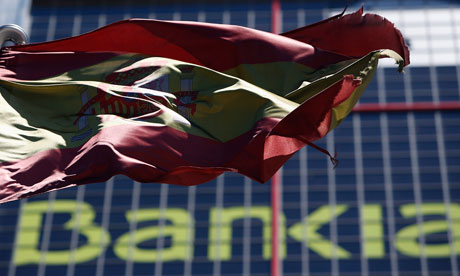
A Spanish flag flutters in front of the headquarters of Bankia
Bankia, Spain’s fourth biggest lender, has already been forced to seek government support in the Spanish banking crisis. Photograph: Sergio Perez/Reuters


Moody's has cut the ratings of 15 of the world's biggest banks, hours after the markets were digesting the admission by Spain that its banks could need up to €62bn of bailout money to see them through the next three years.

The result of the independent audit of Spain's banks put the gap in their finances at between €16bn and €62bn – similar to the €50bn calculated by the International Monetary Fund (IMF) two weeks ago.

Banking giants including Bank of America, Barclays, Citigroup, HSBC, Goldman Sachs, Morgan Stanley and Royal Bank of Scotland all had their credit ratings cut.

The ratings agency said the cuts reflected declining profitability
in an industry suffering from a slowdown in economic growth, tougher
regulations and nervous investors.

Friday, June 22, 2012

The European fiscal treaty is an enemy to democracy


Because no elected government would stand a chance of revoking this policy, I will vote against the ratification


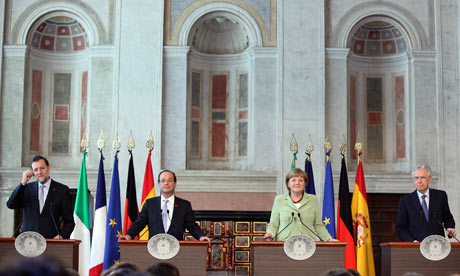
  • Spain's Mariano Rajoy, France's Francois Hollande, Germany's Angela Merkel and Italy's Mario Monti


Spain's Mariano Rajoy, France's Francois Hollande, Germany's Angela Merkel and Italy's Mario Monti at a media conference in Rome ahead of next week's summit of EU leaders. Photograph: Franco Origlia/Getty Images


Germany's Chancellor Angela Merkel has been key in deciding the course of the European crisis policy. The fiscal treaty and the European stability mechanism (ESM) are an attempt to dictate this policy indefinitely to the countries in Europe. This strategy, however, ignores two fundamental facts. First, it was only after the worldwide financial crisis in 2008 that the state debts started rising. They did so because of a global recession and the bank rescue packages. It is not true that European countries had been living beyond their means. Second, Merkel's crisis policy ignores the fact that high spending cuts have a negative impact on economic growth.

At worst, this kind of policy leads to a recession. In Greece this policy has been carried to extremes. In recent years the Greek economy has slumped by 20%. This usually happens only in wartime. Youth unemployment in Greece, like in Spain, now runs as high as 50%. The result is a steep decline in tax revenues which leads to a mounting increase of the Greek state debt despite all spending cuts. This policy, in the meantime, has driven the entire eurozone into a recession. The EU commission predicts negative growth for 2012.